Peptide impurity profiling service
Presence of an impurity can be a real issue in drug development. It can considerably lengthen and complicate development times if not characterized in time and incur considerable extra costs. Sometimes the entire formulation has to be reviewed. That's why impurity profiling analysis is an important step in drug development and drug storage.
An impurity is defined as an unwanted compound remaining in a drug formulation other than the active pharmaceutical ingredient (API) or excipients. It can potentially have an effect on the efficacy or safety of the drug.
For this reason, impurity profiling has become essential in order to meet various regulatory requirements, such as ICH, FDA or EMA.
IC-PEPTIDE offers to isolate, identify and quantify impurities that may be present in a peptide-based formulation.
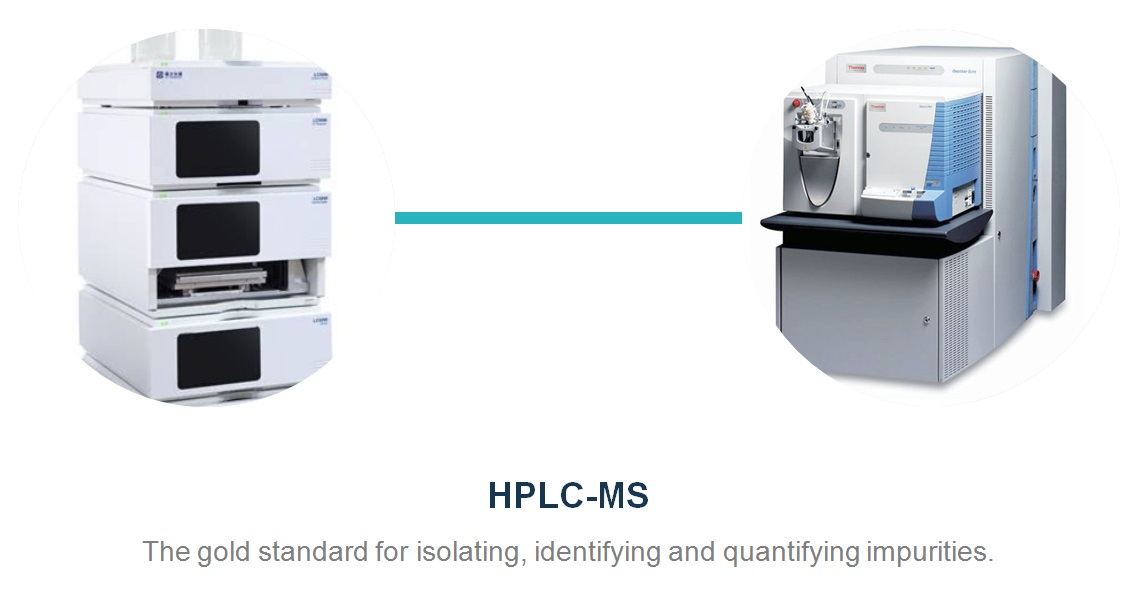
In order to meet these challenges, IC-PEPTIDE has state-of-the-art technologies at its disposal. High Performance Liquid Chromatography (HPLC) is used to separate and quantify chemical compounds. Mass Spectrometry (MS) is used to identify and elucidate the structure of these compounds. NMR can also be employed for further characterizations.
According to the International Conference on Harmonisation (ICH), impurities are divided into 3 categories: organic impurities, inorganic impurities and residual solvents.
The control of impurities is governed by numerous guidelines such as ICH Q3A for impurities in a new drug substance, ICH Q3B for impurities in a new drug product, ICH Q3C, USP 467, and Ph. Eur. 5.4 for residual solvents and volatile impurities. Also ICH Q3D, USP 232 and 233 for elemental impurities testing and risk assessment, and ICH Q6B for product-related and process-related impurities. This regulation requires an expertise that IC-PEPTIDE has acquired.
In a peptide-based API, peptidic impurities can be generated during synthesis but also during purifications, formulation and even storage.
During synthesis, among possible impurities we can cite truncated or incomplete amino acid sequences, incomplete deprotection, amino acid racemization, deamidation, etc.
After synthesis, many other impurities appear such as oxidation, hydrolysis, and deamidation. Combination with parts of the storage material can also occur.
The determination of peptide impurities is a real challenge because they can be structurally close to the API and they can be unexpected. Therefore, high-resolution analysis techniques and solid expertise in peptides are required.
The expertise and equipment at IC-PEPTIDE enable us to address these issues in the best possible way. IC-PEPTIDE is committed to identifying the peptidic impurities in your peptide sample.
Production of recombinant proteins can involve many impurities, such as product-related impurities like host cell proteins, isoform formation or aggregation. Process-related impurities may also be common, such as polysorbate, zwittergents, or growth factors for example.
The technologies available to us, such as ESI-MS/MS, can detect low levels of protein impurities (such as host cell proteins).
IC-PEPTIDE can identify and characterize the impurities in your recombinant protein. Do not hesitate to send your request for quotation.
IC-PEPTIDE can also synthesize your impurities if you wish to further explore them. Contact us for any information.