Peptide purification method development
Peptide purification is generally the most fastidious and expensive step of peptide production. Peptides are amphipathic heteropolymers and each peptide possesses specific characteristics in terms of hydrophobicity, hydrophilicity and charges. Therefore, a specific purification method for each peptide needs to be developed in order to maximize the purification efficiency. For that reason, it is very important to properly integrate the purification method development in the global process of production.
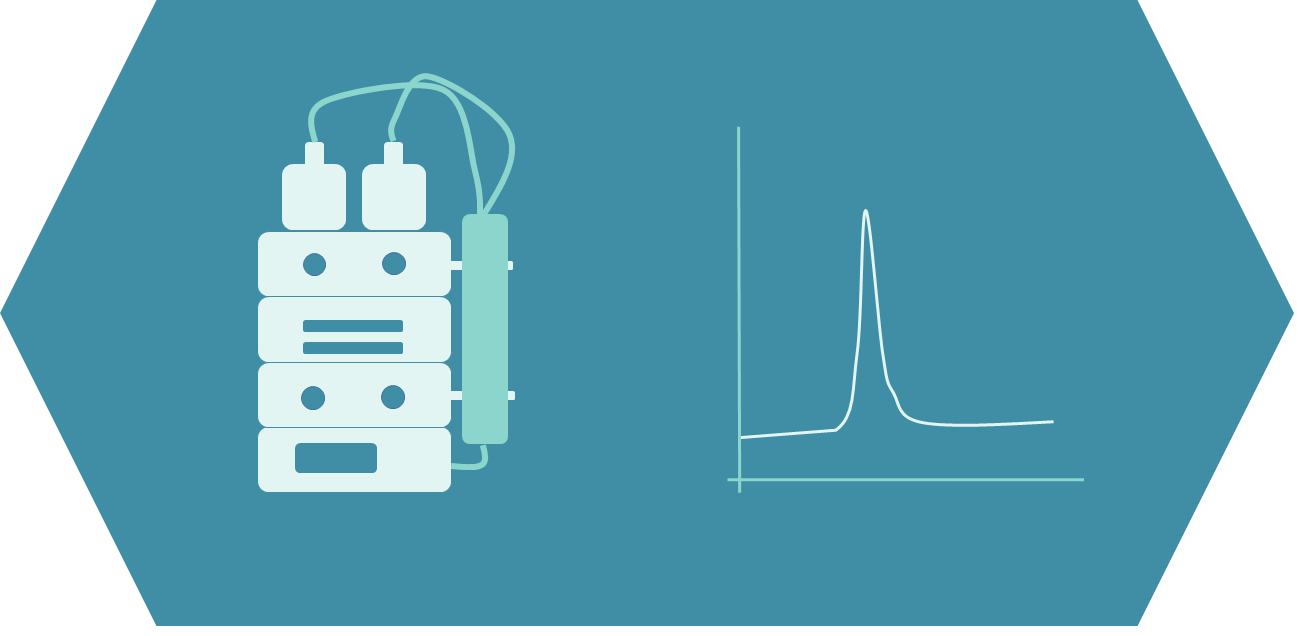
Reversed-phase chromatography represents the state-of-the-art technique for the peptide purification process, but some other techniques depending on peptide properties (hydrophobicity, hydrophilicity, etc.) may exist in order to improve peptide purity rate. In some cases, orthogonal methods may be used to achieve the desired purity rate. Many parameters can be tuned to obtain the best results, such as mode (C18, C12, C3, IEX, mixed mode, etc.), gradient, temperature, pH, buffer, particle size, etc.
A key step in the peptide purification method development is the identification of critical impurities. Critical impurities are those closely eluting with the target product, which are consequently hard to eliminate. Optimizing peptide purification methods to properly separate the target peptides from close impurities is a major step in the process development.
IC-PEPTIDE uses a screening panel of different chromatography media and other tunable parameters to obtain the best results. IC-PEPTIDE can manage global process method development or only synthesis or purification method development separately.
Developed methods can then be transferred to clients or subcontractors.
Contact us for further details.